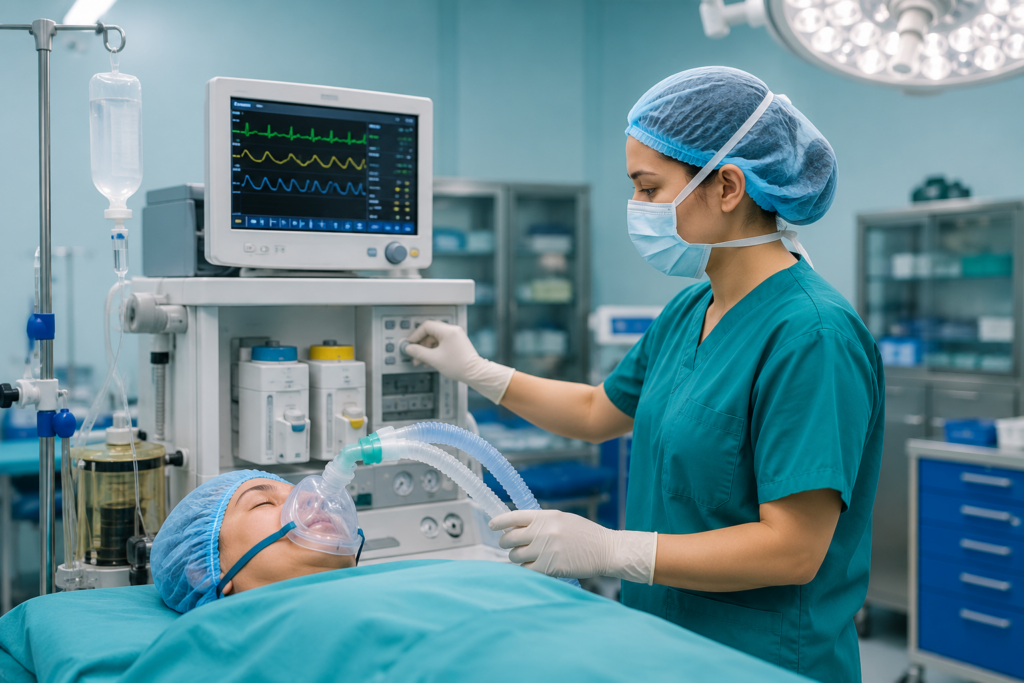
Training the anaesthesia professionals who keep patients safe in surgery — a discipline where precision, vigilance, and clinical skill save lives every day.
The Department of Anesthesia Techniques prepares students for one of the most critical and demanding roles in the surgical environment. Anaesthesia technicians work alongside anaesthesiologists and surgical teams to ensure patient safety before, during, and after operative procedures.
The curriculum covers anaesthetic pharmacology, airway management, patient monitoring, intravenous therapy, regional anaesthesia assistance, and perioperative care — combining deep theoretical knowledge with extensive clinical practice in simulation labs and teaching hospitals.
As Iraq's surgical capacity expands and healthcare infrastructure develops, the demand for skilled anaesthesia technicians continues to grow. Our graduates are prepared to work confidently and competently in operating theatres, intensive care units, and emergency departments.
150+
Students
14
Faculty Members
6
Years Active
310+
Graduates
Direction & Purpose
Vision & Mission
🔭
Vision
To be a leading department in anaesthesia technology education in Iraq — producing graduates who are clinically excellent, safety-conscious, and capable of working at the highest standards in surgical environments across the country and the region.
🎯
Mission
To provide a comprehensive, clinically immersive anaesthesia techniques education that develops graduates with the pharmacological knowledge, patient monitoring skills, and professional discipline required to support safe and effective anaesthetic care in Iraqi healthcare settings.
Strategic Direction
Objectives & Goals
Provide thorough grounding in anaesthetic pharmacology, drug interactions, dosage calculation, and agents used in general and regional anaesthesia.
Develop proficiency in airway management techniques including mask ventilation, intubation assistance, and supraglottic airway devices.
Train students in patient monitoring — ECG interpretation, pulse oximetry, capnography, and haemodynamic assessment.
Equip graduates with skills in intravenous access, fluid management, blood product administration, and intraoperative support.
Build competency in assisting with spinal, epidural, and regional nerve block anaesthesia under clinical supervision.
Foster understanding of perioperative patient care — preoperative assessment, intraoperative vigilance, and post-anaesthesia recovery.
Develop crisis resource management skills: recognising and responding to anaesthetic emergencies including anaphylaxis and malignant hyperthermia.
Establish clinical placement partnerships with teaching hospitals to ensure graduates gain real operating theatre experience.
Prof. [Head Name]
Head of the Department
From the Department Head
A Message from the Head of Department
In the operating theatre, there is no margin for error. Our department was founded to produce anaesthesia technicians who understand this responsibility deeply — who are not merely technically competent, but who possess the situational awareness, calm under pressure, and professional discipline that safe anaesthetic care demands. We train our students in state-of-the-art simulation facilities and real clinical environments, because we know that the skills we teach will one day protect lives. I am honoured to lead this department and proud of every graduate who goes on to serve Iraq's surgical teams.
Academic Focus
Research & Specialisations
Airway Management
Intubation techniques, difficult airway algorithms, video laryngoscopy, and supraglottic devices.
Patient Monitoring
Intraoperative haemodynamic monitoring, depth of anaesthesia assessment, and multimodal vigilance.
Anaesthetic Pharmacology
General and regional anaesthetic agents, opioid analgesics, neuromuscular blocking drugs, and reversal agents.
Regional Anaesthesia
Spinal, epidural, and peripheral nerve block techniques, ultrasound guidance, and pain management.
Perioperative Care
Preoperative assessment, risk stratification, post-anaesthesia recovery, and enhanced recovery protocols.
Anaesthetic Emergencies
Malignant hyperthermia, anaphylaxis, local anaesthetic toxicity, and crisis resource management.
Graduate Outcomes
Career Paths
Graduates are equipped for rewarding careers across Iraq's hospitals, specialist clinics, and healthcare institutions — as well as opportunities in research and academia.